Own the source
Your editable React/Vite app lives under Assets/ReLayerUser. Package updates do not rewrite it.
 ReLayer
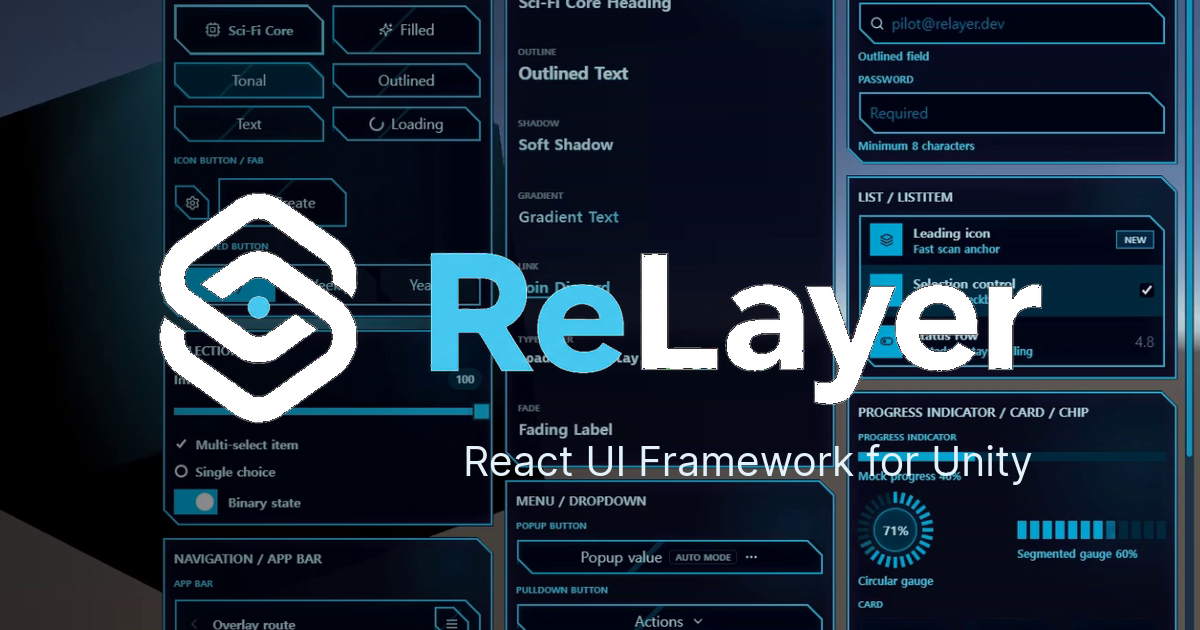
Build HUDs, menus, live-ops screens, and full-screen overlays with editable React, Vite, HTML, and CSS—connected to Unity through structured events.
01 / Workflow
Your project owns the editable overlay. ReLayer handles Play Mode preview, the Unity bridge, and current production output without replacing your UI on package updates.
Open the generated starter scene or add one ReLayer Initializer to an existing scene.
Assets/ReLayerUser/ScenesWork in the project-owned template while managed Vite development applies HMR in Play Mode.
Assets/ReLayerUser/Overlay/TemplateReLayer creates current production output before Unity writes the player build.
Assets/StreamingAssets/ReLayer/overlay02 / Product
Use familiar web conventions for the screens that change most while Unity remains the authority for gameplay, scenes, assets, and player builds.
Your editable React/Vite app lives under Assets/ReLayerUser. Package updates do not rewrite it.
Auto mode manages an isolated Vite work copy and HMR, with a verified built-overlay fallback.
Send named events and payloads between C# and React through readable APIs and inspector relays.
Player builds refresh the active overlay before packaging production output through StreamingAssets.
Start with component kits, themes, responsive surfaces, asset access, and camera-render examples.
Mark interactive React surfaces. Transparent overlay regions remain available to Unity.
Built-in showcase
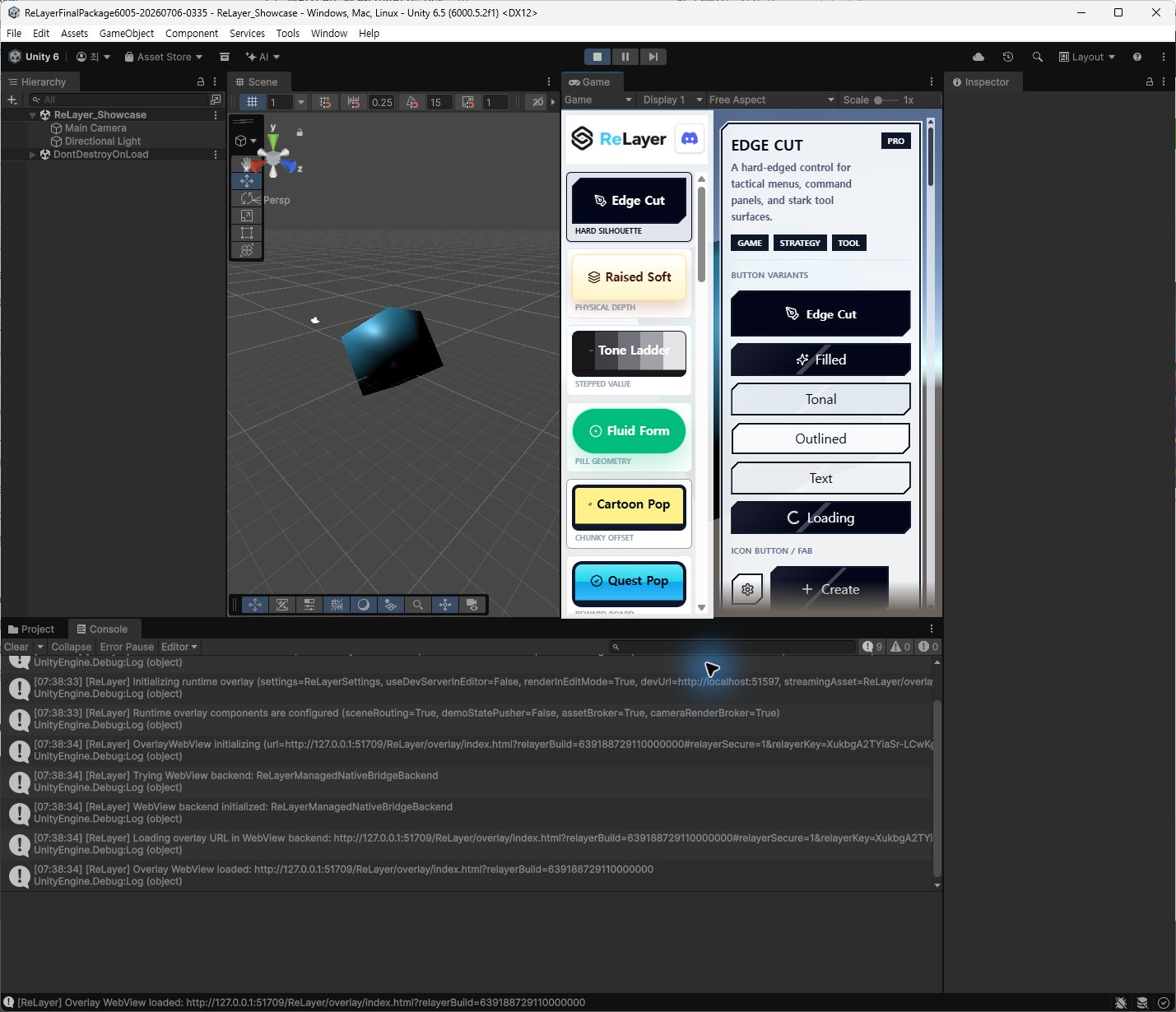
Explore component and theme examples, bridge events, Asset Broker access, Camera Render Broker previews, and portrait and landscape modes. The packaged Showcase runs without Node.js.
See what is included03 / Live Twin
Open an interactive browser twin of the active Unity Play Mode WebView. Click, focus, type, select, scroll, use keyboard and pointer actions, hover, drag, and submit forms while the Unity WebView remains the single authority.
Session
play-01 / epoch 4
Authority
Unity WebView
Revision
settled / 184
Transport
127.0.0.1 only
Allowlisted actions
ReLayerBridgeManager.GetOrCreate().Send(
  ReLayerBridgeEventType.UnityToUiToast,
  new ReLayerToastPayload {
    title = "Quest complete",
    body = "Reward added."
  }
);bridge.send('UI_ACTION', {
action: 'claim-reward',
questId: 'daily-07'
})04 / Bridge
Unity sends routes, player state, toasts, and resource results to React. React sends UI actions and requests back through authenticated bridge frames. Use the C# API directly or connect inspector-friendly UnityEvent relays.
Explore the bridge guide05 / Runtime matrix
ReLayer reports a missing compatible backend instead of silently presenting an unsupported target as covered.
WebView2
Windows Editor and x86_64 players. Microsoft Edge WebView2 Runtime required.
Android WebView
API level 21+ with packaged arm64-v8a and x86_64 native libraries.
WKWebView
Apple Silicon arm64 on macOS 11 or newer.
WKWebView
arm64 devices on iOS 12+ and arm64 Simulator on Apple Silicon with iOS 14+.
Same-document DOM
Browser DOM layer aligned with the Unity canvas. Production requires HTTPS.
Windows ARM64, Intel macOS, Universal macOS players, Intel iOS Simulator, Android 32-bit, and Linux are outside the bundled first-party runtime matrix. WebGL validation covers Unity 2022.3.62f2 IL2CPP with desktop Chrome and Edge.
Read platform requirements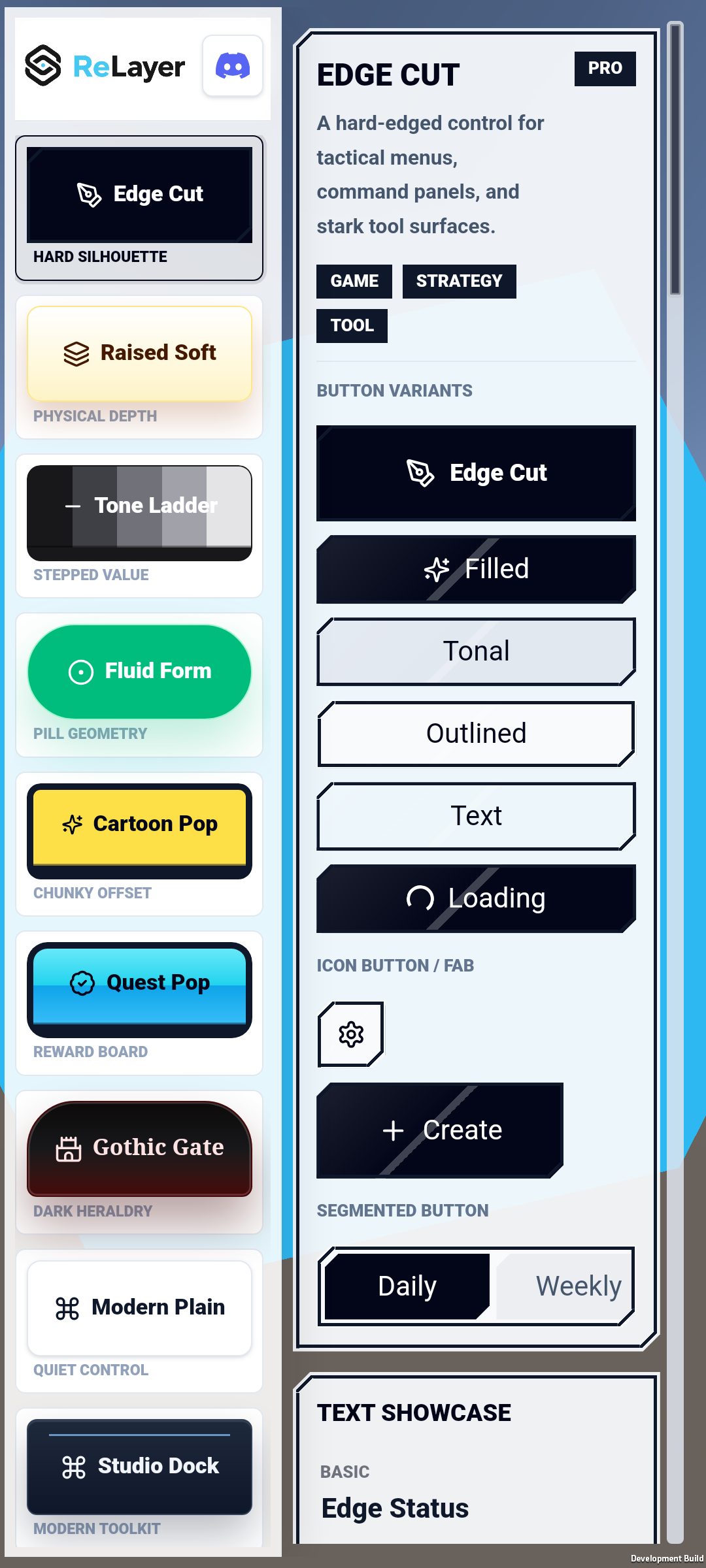
06 / Documentation
First import, starter scene, project-owned source, and the first production build.
Browser control, source-aware inspection, security boundaries, and known limitations.
Named events, payloads, safe areas, runtime connection checks, and hit testing.
Runtime requirements, HTTPS, CORS, CSP, and Unity compressed-output headers.
Stable kit imports, reusable controls, glass surfaces, and project-owned forks.
Node toolchains, WebView2, stale builds, input regions, and Live Twin diagnostics.
Product walkthrough
Tour the Showcase, component themes, bridge workflow, and the UI running as a Unity overlay.
Start building
Get the asset, then begin with a project-owned React/Vite overlay that remains yours to customize.